Deconstruction of Venus
H124 W45cm. Coloured stains, stoneware glazes. Six-piece stacking form
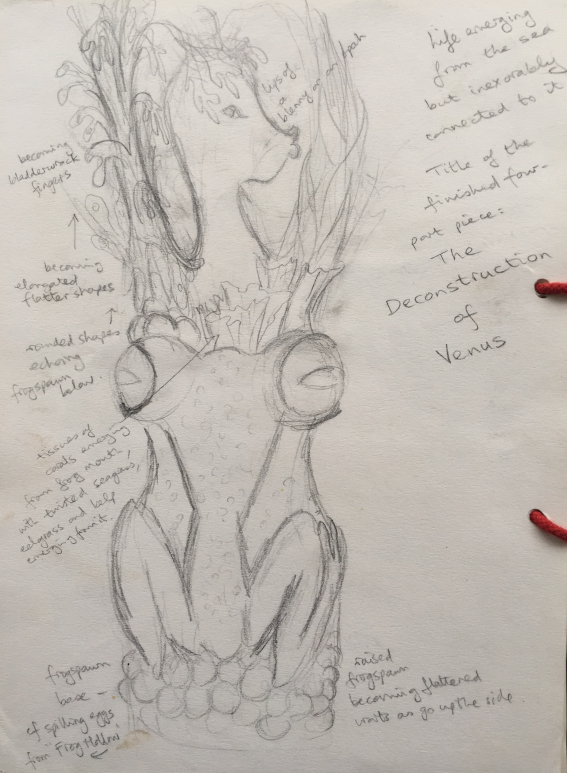
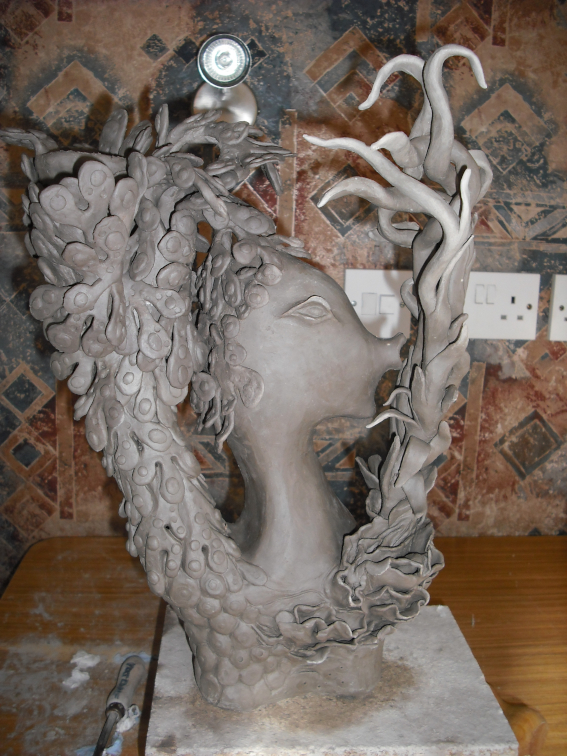
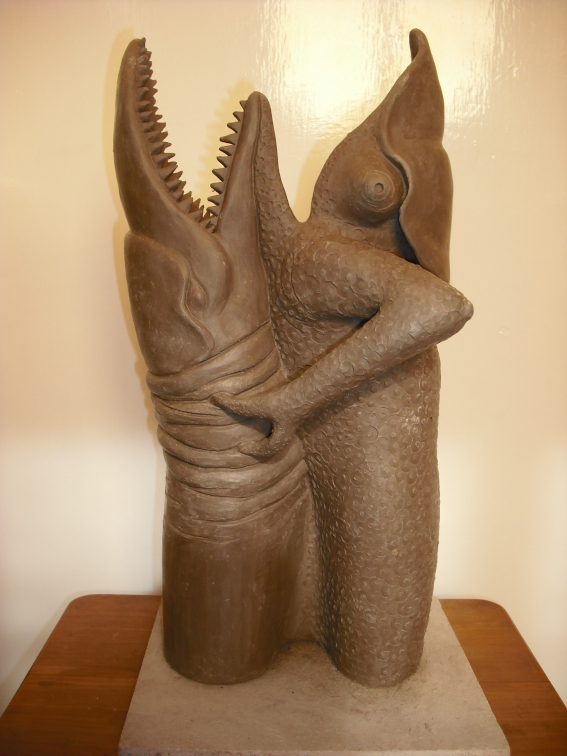
The goddess in Botticelli’s Birth of Venus, 1480s, emerges from a scallop as a fully grown woman. Deconstruction of Venus follows a more evolutionary trail. The paired base represents bisexual reproduction, with its propensity for mutation, necessary for evolution. The left foot is a primitive sightless fish, one fin stretching out along the ground, limb-like. Its tail is suggestive of Hokusai’s Great Wave, 1831, a freak pyramidal wave – a wave mutation. The creature emerging from its mouth to form a leg is an amalgam of sturgeon (fish) and dolphin (cetacean). The dolphin is a Christian symbol of salvation, with tales of dolphins rescuing sailors, but only those who hadn’t eaten dolphin flesh. Can mankind be saved from self-destruction by life-forms it has exploited? The right foot is a double-headed ammonite. One head remains coiled in the sea, sprouting sponge tentacles, linking it to an earlier yet enduring form of life. The other reaches for air, hatching out a chameleon, that coiled-tail master of pretence, to form the second leg. Both creatures spew eggs, as does the frog above the mass of spawn. As an amphibian it precedes the reptile, showing successful life forms survive. The frog’s eyes echo the shape of breasts, so the emerging final creature is acceptably mammalian despite her bladder-wrack encrusted arms and head, illustrating the interconnection of plant and animal life. The fingers of vegetation grow from her arms like strands of hair on Botticelli’s Venus, representing branches of what might have been and what is yet to come.